
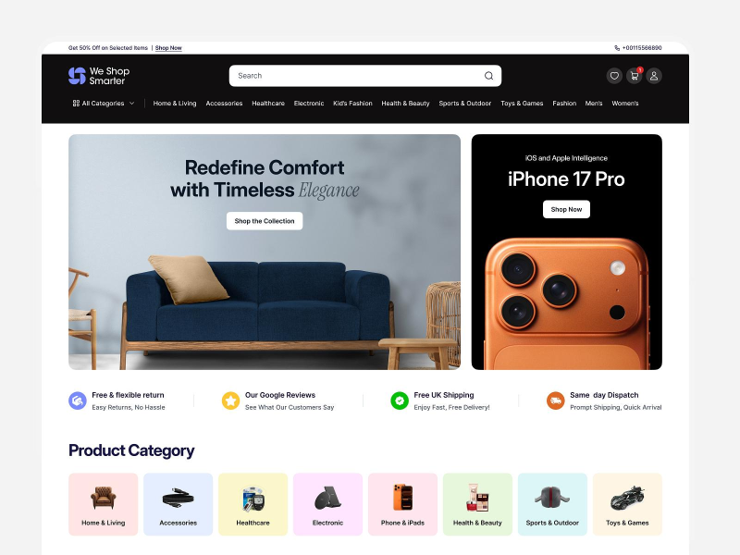
Driving traffic to an online store is only half the battle. You can invest heavily in paid search, social media campaigns, and influencer partnerships, but if your site fails to turn those clicks into paying customers, your return on investment will drop significantly.
Building a high-converting e-commerce website requires more than a visually pleasing layout. It demands strategic e-commerce website design, seamless technical functionality, fast load speeds, and a user experience engineered to guide visitors smoothly from the home page to the final checkout confirmation.
1. Plan for Strategy and Architec ture Before Design
Before selecting a platform or writing a single line of code, you need a structured plan. Successful e-commerce website development starts with defining your target audience and mapping out how they will navigate your store.
- Map out clear user journeys: Define the exact paths distinct user personas will take. A first-time visitor looking for a specific item needs a different route than a returning customer searching for discounts.
- Establish an intuitive site hierarchy: Keep your navigation simple. Use broad, logical parent categories and detailed subcategories so users can find products within three clicks.
- Conduct market and competitor research: Analyze high-performing competitors in your niche to identify effective design choices, category structures, and user interfaces.
2. Choose the Right Platform and Tech Stack
Selecting the right foundational technology is critical when evaluating e-commerce website development services or building in-house. Your platform should support your current catalog size while accommodating future growth.
| PLATFORM | BEST FOR | KEY ADVANTAGES |
| Shopify | Small to mid-market | Fast setup, low maintenance |
| WooCommerce | WordPress sites | High customizability |
| Adobe Commerce (Magento) | Large enterprise stores | Advanced inventory scaling |
| Custom Headless | Omnichannel brands | Complete front-end control |
When evaluating platforms, prioritize API integrations, built-in security compliance, scalable database management, and mobile performance.
3. Prioritize Mobile-First E-Commerce User Experience
More than half of all global web traffic originates from mobile devices. If your site is only optimized for desktop screens, you risk losing significant sales.
- Implement responsive design: Ensure elements automatically scale to fit any viewport, from large desktop monitors to compact smartphones.
- Optimize touch targets: Buttons, form fields, and navigation links must be large enough to tap easily without accidental clicks.
- Simplify mobile navigation: Use sticky headers, hamburger menus, and prominent search bars to keep navigation frictionless on mobile devices.
4. Design High-Converting Product Pages
Your product page serves as your digital sales pitch. Because customers cannot physically touch or inspect products online, your online shopping website design must provide clarity, answer questions, and build immediate trust.
| ANATOMY OF A HIGH-CONVERTING PRODUCT PAGE • Detailed Visual Media: High-res photos, 360-degree interactive viewer, product context video. • Clear Header Info: Product Title, Category, Star Ratings & Customer Review Count, Clear Price & Savings. • Call to Action & Options: Variant Selectors (Size, Color, Quantity), Sticky ‘ADD TO CART’ CTA, ‘BUY NOW’ one-click checkout. • Trust & Reassurance: Trust Badges (Free Shipping, Secure Payment, Money-Back Guarantee). • Detailed Tabs: Full Description, Technical Specs, Shipping & Returns Policy, Customer Reviews & User Q&A. |
Key Product Page Elements:
- High-quality visuals: Use crisp, zoomable images showing the product from multiple angles, alongside short video demonstrations.
- Clear Value Propositions: Position key details—such as materials, dimensions, and warranty terms—near the top of the page.
- Social Proof: Display authentic customer reviews, star ratings, and user-submitted photos directly on the product page to build confidence.
5. Implement Smart Search and Navigation
Visitors who use site search convert at up to two to three times the rate of casual browsers because they enter with strong purchase intent.
- Deploy AI-powered predictive search: Show real-time product suggestions, auto-corrections, and category previews as users type in the search bar.
- Use dynamic faceted filtering: Allow visitors to quickly filter products by size, price range, color, brand, and customer rating without refreshing the page.
- Avoid zero-result pages: If a search query yields no direct matches, display related products, top-selling items, or helpful category recommendations.
6. Build Trust and Eliminate Purchasing Friction
Online shoppers hesitate when they feel uncertain about security, shipping costs, or return policies. Addressing these concerns upfront helps increase conversions across your site.
- Display security seals and SSL badges: Feature trusted security logos and payment processor icons near payment forms and CTAs.
- Be transparent about costs: Avoid hidden fees at checkout. Display estimated shipping costs and taxes early in the user journey or on the cart page.
- Offer a clear return policy: Highlight straightforward money-back guarantees or free return policies prominently across product and checkout pages.
7. Streamline the Checkout Process
Cart abandonment remains one of the largest sources of lost revenue in online retail. Simplifying the final steps can capture sales that might otherwise be lost.
| STEP 1: IDENTIFICATION | STEP 2: SHIPPING | STEP 3: PAYMENT |
| • Guest Checkout | • Address Auto-complete | • Saved Cards / Digital Wallets |
| • One-Click Social Login | • Clear Delivery Dates & Rates | • Buy Now, Pay Later (BNPL) Options |
- Offer guest checkout: Allow customers to complete purchases without creating a mandatory account. You can offer account creation after the order is placed.
- Integrate express digital wallets: Provide one-touch payment options like Apple Pay, Google Pay, and PayPal alongside traditional credit card processing.
- Reduce form fields: Use address auto-completion tools to minimize manual typing on mobile devices.
8. Optimize Technical Performance and Speed
Page speed directly influences search rankings and conversion rates. Even a one-second delay in page load time can reduce conversions significantly.
- Compress visual assets: Compress images using modern formats like WebP or AVIF without sacrificing visual quality.
- Use a Content Delivery Network (CDN): Serve static assets from global servers geographically close to your visitors to reduce latency.
- Minify code: Clean up unnecessary JavaScript, CSS, and HTML to reduce browser rendering times.
9. Utilize Continuous Testing and Optimization
Optimizing an online store is an ongoing process. To keep conversion rates growing, track user interactions and systematically test potential improvements.
- Run A/B tests: Test variations of button placements, CTA wording, hero images, and pricing layouts to see what resonates best with your audience.
- Analyze behavior with heatmaps: Use tools to observe where users click, how far they scroll, and where they tend to abandon the page.
- Track key performance metrics: Regularly monitor your overall conversion rate, average order value (AOV), cart abandonment rate, and bounce rate to pinpoint areas for improvement.
Conclusion
Building an e-commerce website that turns traffic into revenue requires balancing technical stability, intuitive design, and user psychology. By prioritizing mobile performance, sharpening product pages, eliminating checkout friction, and continuously testing your layout, you can build a scalable store that turns casual visitors into repeat buyers. Navigating the complexities of custom e-commerce website development can be challenging without the right partner. SeeSam Solutions can help you build, optimize, and scale a high-converting online store tailored specifically to your business goals. From designing mobile-first user experiences and integrating advanced payment gateways to executing conversion rate optimization (CRO) strategies, SeeSam Solutions delivers end-to-end e-commerce website development services designed to maximize sales and elevate your brand’s digital presence.