
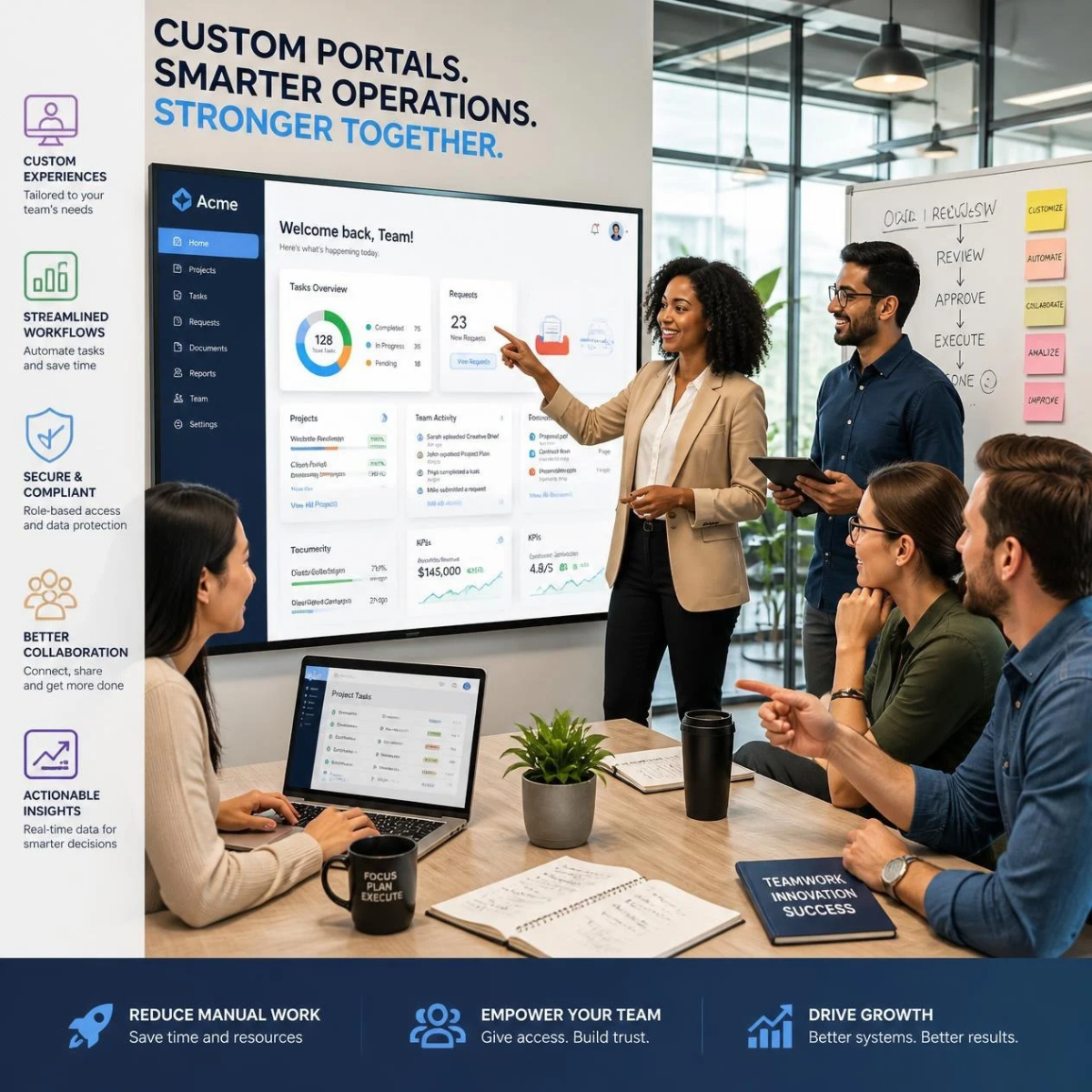
Modern businesses are expected to operate faster, communicate more effectively, and deliver better experiences while managing increasingly complex processes. From customer communication and employee collaboration to document management, approvals, reporting, and data access, organizations often rely on multiple systems to keep their operations running. While these tools can solve individual problems, managing too many disconnected platforms can create new challenges.
Information may be scattered across emails, spreadsheets, messaging applications, shared folders, and separate software systems. Employees may spend valuable time searching for information, entering the same data repeatedly, following up on approvals, or manually preparing reports. Customers and business partners can also experience delays when they need information or services that depend on internal teams.
This is where custom web portals can make a significant difference.
A custom web portal is a centralized, web-based platform designed around the specific requirements of an organization. Rather than forcing a business to adapt its processes to generic software, a custom portal can be structured around existing workflows, users, data, and operational requirements.
For businesses looking to improve efficiency, custom web portal development can become an important part of their digital transformation strategy. A well-designed portal can bring information, processes, people, and services together in one secure environment while reducing repetitive work and improving visibility.
What Is a Custom Web Portal?
A web portal is an online platform that provides users with access to information, services, tools, and workflows through a centralized interface. Unlike a standard website, which primarily provides information to visitors, a portal is generally interactive and can provide different users with different functions based on their roles and permissions.
A custom web portal goes a step further by being developed specifically around the requirements of a particular organization.
Instead of purchasing a generic system and changing business processes to fit the software, businesses can build a portal around the way they actually operate.
This flexibility makes custom portal development for businesses particularly valuable when an organization has specialized workflows, multiple departments, different user groups, or systems that need to work together.
Why Businesses Need Better Digital Workflows
Many operational challenges do not come from a lack of technology. They come from technology that is disconnected.
Consider a business where customer information is maintained in one system, documents are stored in shared folders, approvals are handled through email, and reports are created manually in spreadsheets. Each system may work independently, but employees still have to move information between them.
This can result in:
- Repeated data entry
- Communication gaps
- Delayed approvals
- Difficulty tracking requests
- Duplicate or outdated information
- Limited visibility across departments
- Increased administrative workload
- Greater risk of human error
These challenges can directly affect productivity and customer service.
Business process automation can reduce many of these inefficiencies by allowing routine activities to move through predefined digital workflows. A custom portal can provide the central environment where these workflows are managed.
Instead of asking employees to work around disconnected systems, businesses can create a more structured and centralized digital experience.
1. Centralize Business Information
One of the most important benefits of custom web portals is centralized information.
Businesses generate and manage large amounts of information every day. Customer details, employee records, documents, purchase information, service requests, approvals, reports, and operational data can quickly become difficult to manage when they are stored across different platforms.
Authorized users can access the information they need without searching through multiple systems or contacting different departments for basic updates.
For example, a customer service team could access customer profiles, previous requests, documents, and service information from a centralized portal. Management could access dashboards and reports without waiting for individual teams to compile information manually.
Centralized information can improve both productivity and consistency.
It also helps organizations establish a more structured approach to data management, ensuring that important information is easier to locate, update, and monitor.
2. Streamline Business Processes
Every organization has processes that are repeated regularly.
These may include submitting requests, reviewing documents, approving expenses, processing orders, assigning tasks, managing customer inquiries, or generating reports.
When these activities are handled manually, employees may need to send emails, update spreadsheets, make phone calls, and follow up repeatedly.
Custom web portals can help streamline business processes by converting manual activities into structured digital workflows.
For example, instead of an employee emailing a request to a manager, a portal could allow the employee to submit the request directly. The system could automatically notify the relevant approver, record the decision, update the request status, and maintain a digital record.
This is a practical example of workflow management.
The objective is not simply to make a process digital. The goal is to make it easier to manage, monitor, and complete.
3. Improve Operational Efficiency
Time is one of the most valuable resources for any organization.
Employees frequently spend significant amounts of time performing administrative tasks that do not directly contribute to business growth. Searching for documents, entering information multiple times, checking request statuses, and preparing repetitive reports can all consume working hours.
Custom web portals can improve operational efficiency by reducing unnecessary manual activities.
Automated notifications, predefined workflows, centralized records, dashboards, and role-based access can help employees complete tasks more efficiently.
For management, improved visibility can also make it easier to identify bottlenecks and understand where processes are slowing down.
Over time, these improvements can contribute to greater business productivity.
The value of a portal therefore extends beyond the technology itself. A successful portal should help people spend less time managing processes and more time focusing on meaningful business activities.
4. Support Business Process Automation
Business process automation is another major advantage of custom web portals.
Automation allows repetitive activities to be handled according to predefined rules. Depending on the business requirement, a portal can automate notifications, task assignments, approvals, status updates, data collection, reporting, and other routine activities.
Imagine a company that receives hundreds of internal requests every month.
Without automation, employees may manually review emails, identify responsible departments, forward requests, and follow up for updates.
With a custom portal, the workflow could be structured as:
- User submits a request.
- Portal records the information.
- Request is automatically assigned.
- Responsible employee receives a notification.
- Approval is requested when necessary.
- Status is updated automatically.
- User receives progress updates.
- Completed request is stored for future reference.
This type of automated workflow can reduce administrative effort while improving accountability.
5. Create Better Employee Portals
Employees need quick access to the information and tools required for their work.
An employee portal can provide a centralized digital environment where staff members can access company information, documents, requests, announcements, workflows, and internal services.
Instead of depending on multiple communication channels, employees can use one platform for relevant activities.
Depending on the organization, an employee portal may include:
- Internal documents
- Request forms
- Approval workflows
- Department information
- Task tracking
- Company announcements
- Knowledge resources
- Internal reporting
- Employee directories
- Service requests
Because access can be based on user roles, different employees can see the information and functions relevant to their responsibilities.
6. Improve Customer Experiences
Businesses are no longer evaluated only by the quality of their products or services. Customers also expect convenient digital experiences.
A customer portal can provide customers with direct access to relevant information and services without requiring them to contact the business for every request.
Depending on the industry, customers may be able to:
- View account information
- Submit inquiries
- Track service requests
- Access documents
- View orders
- Download invoices
- Check status updates
- Submit support requests
- Communicate with service teams
This can improve convenience while reducing repetitive inquiries for internal employees.
A well-designed customer portal can therefore support both customer satisfaction and operational efficiency.
7. Strengthen Collaboration Between Teams
Departments often depend on each other to complete processes.
Sales may require information from finance. Customer service may need information from operations. Management may require reports from several departments.
When teams work through disconnected systems, collaboration can become slow.
Custom web portals can provide a shared environment for team collaboration.
Relevant users can access the same information, monitor progress, assign tasks, and communicate through structured workflows.
This reduces dependency on long email chains and makes it easier to determine who is responsible for the next step.
For organizations with multiple departments, this visibility can have a significant impact on productivity.
8. Provide Secure Online Access
Security is an essential consideration when businesses manage customer, employee, financial, or operational information.
Custom web portals can be designed with secure online access based on organizational requirements.
Features may include authentication, role-based permissions, access controls, activity logs, and other security mechanisms.
For example, a finance employee may have access to financial records while a customer service representative may only access customer service information.
This type of role-based access can help businesses control who can view or manage particular information.
Security should be considered from the beginning of custom web portal development, rather than treated as an afterthought.
9. Connect Different Business Systems
Many organizations already use software systems for accounting, customer relationship management, document management, inventory, human resources, or other functions.
Replacing every existing system may not be practical.
Instead, a custom portal can potentially act as a centralized interface that connects relevant systems and provides users with a more consistent experience.
This can reduce the need for employees to switch between multiple applications.
10. Make Reporting and Decision-Making Easier
Business leaders need reliable information to make informed decisions.
However, when data is spread across spreadsheets and different applications, preparing reports can take considerable time.
A custom portal can provide dashboards and reporting tools that present important information in a structured format.
Management may be able to monitor:
- Pending requests
- Completed tasks
- Approval status
- Customer activity
- Operational performance
- Department workload
- Service response times
- Other business-specific indicators
Real-time information sharing can help decision-makers understand current conditions rather than relying exclusively on manually prepared reports.
Better visibility can support more informed process optimization and strategic planning.
11. Reduce Repetitive Data Entry
Repeated data entry is one of the most common sources of administrative inefficiency.
When the same information needs to be entered into several systems, employees spend additional time performing repetitive work. There is also an increased possibility of inconsistent or incorrect information.
A centralized portal can reduce unnecessary duplication by allowing information to be entered once and reused across relevant workflows or integrated systems.
This supports better data management while reducing manual workload.
The result can be a more consistent operational environment where employees spend less time maintaining records and more time acting on information.
12. Improve Accountability and Tracking
When a process is handled through emails or informal communication, it can be difficult to determine what happened, when it happened, and who was responsible.
Custom web portals can provide structured tracking.
Each request or workflow can have a status, responsible user, timestamp, and activity history.
This creates greater transparency.
Managers can identify pending activities, employees can see their assigned tasks, and users can track the progress of their requests.
This level of visibility is particularly useful for organizations that manage high volumes of transactions or service requests.
13. Build Partner and Vendor Portals
Businesses do not operate in isolation. They often work with distributors, suppliers, contractors, resellers, service providers, and other partners.
A partner portal can provide external stakeholders with controlled access to relevant information and processes.
For example, partners may be able to submit documents, check order information, access resources, submit requests, or monitor workflow status.
This can reduce manual communication and create a more structured relationship between the business and its partners.
For organizations with extensive partner networks, this can become an important part of broader digital business solutions.
14. Improve Scalability
A business that is growing today may have very different operational requirements in the future.
A system that works for a small team may become difficult to manage as the organization adds employees, customers, locations, products, or services.
One of the benefits of custom web portals for business efficiency is that they can be designed with future growth in mind.
Businesses can start with essential functions and expand the portal as requirements evolve.
Additional departments, user groups, workflows, integrations, and reporting features can potentially be introduced over time.
This makes scalability an important consideration when evaluating custom software solutions.
15. Support Digital Transformation
Digital transformation is not simply about purchasing new software. It is about improving the way an organization operates through technology.
Custom web portals can contribute to this transformation by connecting people, information, and processes.
They can help businesses move away from fragmented, manual workflows toward more centralized and automated operations.
For organizations planning a broader digital transformation strategy, a custom portal can become one component of a larger technology ecosystem.
What Should a Business Consider Before Developing a Portal?
Before starting custom web portal development, organizations should clearly define what problem they are trying to solve.
Important questions include:
- Which processes are currently inefficient?
- Who will use the portal?
- What information should each user access?
- Which workflows should be automated?
- Which existing systems need integration?
- What security requirements exist?
- What reporting capabilities are required?
- How will the portal scale in the future?
Starting with business requirements rather than technology helps ensure that the final solution provides practical value.
A portal should not be developed simply because having a portal sounds modern. It should address measurable operational needs.
Conclusion
The way businesses operate is changing rapidly. Customers expect convenience, employees need faster access to information, managers require better visibility, and organizations must find ways to accomplish more without increasing unnecessary administrative work.
Custom web portals can help address these challenges by creating a centralized platform designed around the unique needs of a business.
From business process automation and workflow management to centralized information, secure online access, customer service, team collaboration, and reporting, a well-designed portal can improve multiple areas of an organization’s operations.
For organizations exploring custom web portal development, the starting point should always be the business problem: What needs to become faster, simpler, more secure, or more efficient?
Once those priorities are clear, the right custom software solutions can turn technology into a practical business advantage. With the right strategy and implementation, SeeSam Solutions can be part of that digital journey, helping businesses explore technology-driven approaches for more connected, efficient, and scalable operations.