
Imagine spending tens of thousands of dollars on pay-per-click advertising, social media campaigns, search engine optimization, and high-converting product photography, only to lose your buyers at the very last second. This heartbreaking scenario is an everyday reality for thousands of e-commerce brands across the globe. You successfully entice shoppers onto your website, build product interest, and convince them to click ‘Add to Cart’—yet when it comes to completing the transaction, the funnel breaks.
According to comprehensive research conducted by the Baymard Institute, the average global shopping cart abandonment rate hovers around 70% across virtually all retail verticals. This staggering statistic means that out of every ten potential customers who actively demonstrate purchase intent by building a shopping cart, seven walk away without spending a single dollar. For an online store generating $100,000 in monthly revenue, a 70% abandonment rate implies that over $230,000 worth of potential sales is slipping through the cracks every single month.
Why do so many high-intent shoppers abandon their purchase at the finish line? The primary driver of lost revenue is checkout friction. A clunky multi-page layout, unexpected hidden costs, mandatory user registration, and slow page performance shatter consumer trust right at the critical moment of decision. Optimizing your online checkout experience is undeniably the highest-leverage growth strategy available to online retailers. By taking strategic steps to reduce cart abandonment, improve checkout process mechanics, and refine overall website conversion, you can dramatically scale your online sales without spending an extra dime on traffic acquisition.
1. The Psychology and Micro-Economics of Shopping Cart Abandonment
To successfully repair leaks in your digital purchase funnel, you must look beyond macro-level analytics and analyze the psychological friction points that cause shoppers to hesitate. The moment a consumer navigates to your checkout page, their mindset shifts from emotional desire to risk evaluation.
| E-Commerce Funnel Breakdown: [ Traffic Acquisition ] ➜ [ Product Selection ] ➜ [ High Purchase Intent ] ➜ [ Friction / Hidden Fees ] ➜ [ Cart Abandonment ] |
The Primary Friction Drivers Impacting Conversion Rate
- Unexpected Extra Costs & Shipping Shock: Over 48% of shoppers abandon carts because shipping fees, service charges, or unexpected taxes are added at the very last step. When prices increase unexpectedly at checkout, consumers feel deceived.
- Forced Account Creation: Requiring users to register a permanent password and fill out non-essential profile fields creates unnecessary cognitive load. Modern shoppers prioritize speed and convenience above all else.
- Excessive Form Field Complexity: Asking for unnecessary information—such as phone numbers, second address lines, or billing addresses when they match shipping—increases data entry fatigue and mobile micro-errors.
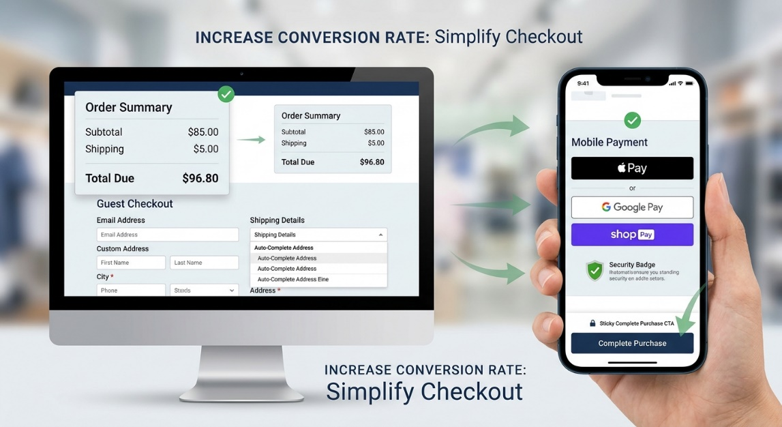
- Lack of Payment Method Diversity: Restricting payment options to basic credit cards alienates mobile users who rely on express wallets like Apple Pay, Google Pay, Shop Pay, or flexible Buy Now, Pay Later (BNPL) options like Klarna and Afterpay.
- Perceived Security Vulnerabilities: An outdated checkout page layout, missing SSL verification indicators, or generic branding triggers anxiety regarding payment data safety.
2. Core Technical Elements of Checkout Page Optimization
Executing a successful checkout page optimization strategy requires balancing user interface simplicity with robust backend infrastructure. Every single friction point removed yields an immediate compound effect on your overall ecommerce conversion rate.
| Friction Area | Legacy Approach (High Friction) | Optimized Strategy (High Conversion) |
| User Onboarding | Mandatory account creation prior to cart access | Seamless Guest Checkout + Post-purchase 1-click account setup |
| Form Data Entry | 12 to 18 manual form fields across multiple screens | Single-column inline layout with Google Address Auto-Complete |
| Price Transparency | Shipping costs calculated on the final payment screen | Upfront dynamic shipping calculator directly inside cart drawer |
| Mobile Navigation | Tiny input buttons, tiny text fields, manual card entry | One-touch biometric wallets (Apple Pay, Google Pay, Shop Pay) |
| Trust & Authority | Generic checkout template with no brand security markers | Visual SSL badges, site security seals, clear return policy links |
3. Proven Strategies to Improve Checkout Process and UX Flow
Implementing Frictionless Guest Checkout
Forcing first-time visitors to create an account before completing a purchase is one of the fastest ways to destroy ecommerce website conversion rates. By enabling guest checkout, you allow shoppers to place an order immediately using only an email address. Once the purchase is confirmed on the order thank-you page, you can invite them to enter a password to save their transaction history. This simple inversion of account registration preserves buying momentum.
Streamlining Form Fields with Smart Auto-Fill APIs
- Google Places Address API: Integrating address auto-complete reduces street address typing by up to 70%, drastically cutting down on input errors on mobile devices.
- ZIP/Postal Code Auto-Detection: Allowing your checkout software to automatically detect state, city, and region based on ZIP code entries eliminates two manual input fields.
- Dynamic Single-Field Name Inputs: Replacing separate ‘First Name’ and ‘Last Name’ inputs with a unified ‘Full Name’ field reduces visual noise and cognitive friction.
Transitioning to Single-Page vs. Accordion Checkout
Traditional multi-step checkout processes require shoppers to navigate across 3 to 4 distinct page reloads (Shipping -> Billing -> Review -> Payment). Every page load introduces network latency and an opportunity to drop off. Adopting a single-page checkout layout—or a responsive accordion layout—ensures users can preview their order details, shipping inputs, and payment choices simultaneously, minimizing drop-off at every step.
4. Advanced Post-Abandonment Recovery Tactics
Even with a world-class checkout experience, a percentage of shoppers will inevitably get distracted or leave. Deploying automated recovery channels ensures you re-engage these high-intent prospects and recover lost revenue.
Automated 3-Part Abandoned Cart Email Sequences
- Sequence Step 1 (1 Hour Post-Abandonment): Send a gentle, helpful reminder email featuring the exact items left in the cart with a direct link back to checkout. Avoid discounting at this early stage.
- Sequence Step 2 (24 Hours Post-Abandonment): Introduce social proof, star ratings, and real customer testimonials for the specific abandoned items to overcome lingering product uncertainty.
- Sequence Step 3 (48 Hours Post-Abandonment): Provide a time-sensitive incentive, such as free express shipping or a 10% discount code, to compel price-sensitive shoppers to complete their purchase.
Exit-Intent Technology and SMS Recovery
Exit-intent technology monitors cursor movement on desktop and backward navigation gestures on mobile devices. When a user indicates intent to abandon the page, a non-intrusive modal can present a quick offer—such as saving their cart to their email inbox or claiming a instant discount code. Furthermore, integrating SMS abandonment messages via platforms like Klaviyo yields opening rates above 90%, recovering carts that traditional email marketing misses.
5. Mobile Checkout Optimization Strategies
Mobile devices account for over 70% of total e-commerce web traffic globally, yet mobile conversion rates routinely lag behind desktop performance by nearly 50%. The primary culprit is the physical constraint of typing card data into small touchscreens.
- Integrating One-Touch Digital Wallets: Offering native Apple Pay, Google Pay, Shop Pay, and PayPal Express integrations allows buyers to complete transactions in under 10 seconds using biometric validation (FaceID or fingerprint recognition).
- Dynamic Input Keypads: Ensure HTML input attributes trigger numeric touch keypads automatically when customers reach credit card, expiration date, ZIP code, or phone number fields.
- Sticky Purchase CTA Placement: Anchor a bold, high-contrast ‘Complete Purchase’ button to the bottom of the mobile viewport so it remains accessible regardless of how far the user scrolls.
6. Building Security, Price Transparency, and Post-Purchase Trust
Shoppers must feel 100% confident that their personal data is protected and that they are getting a fair deal. Transparent pricing and visible trust marks are essential for driving peak conversion rates.
Upfront Transparent Pricing
Eliminate hidden fees entirely. Provide clear, upfront shipping fee calculators and sales tax estimates inside the cart drawer before the buyer clicks into the final checkout page. Showing an exact order breakdown builds customer rapport.
| Sample Transparent Pricing Box: Order Summary Breakdown ─────────────────────────────────── Subtotal: $85.00 Estimated Standard Shipping: $5.00 Estimated Taxes & Fees: $6.80 ─────────────────────────────────── Total Due: $96.80 |
Post-Purchase Upsells and Long-Term Retention
The customer journey does not end when payment is processed. Implementing one-click post-purchase upsells on the order thank-you page—offering complementary accessories or extended warranties without requiring card re-entry—increases Average Order Value (AOV) instantly without increasing checkout friction. Coupled with real-time SMS tracking updates, high-quality post-purchase care ensures repeat purchases and long-term customer lifetime value.
7. Essential E-commerce Metrics to Track Success
Continuous checkout optimization relies on data-driven testing. Ecommerce store owners must monitor three foundational KPIs:
- Checkout Conversion Rate: (Total Completed Transactions / Total Checkout Starts) × 100. This tracks the efficiency of your purchase funnel.
- Cart Abandonment Rate: (1 – (Completed Purchases / Total Carts Created)) × 100. Measures the percentage of interested shoppers who drop off.
- Average Order Value (AOV): Total Revenue / Total Number of Orders. Helps determine if checkout optimizations drive larger cart sizes.
8. Strategic Implementation Action Plan
- Phase 1: Audit & UX Discovery: Analyze current checkout performance using Google Analytics 4, heatmaps, and session recordings to locate exact drop-off steps.
- Phase 2: Quick-Win Implementation: Enable guest checkout, integrate express digital payment wallets (Apple Pay/Google Pay), and remove non-essential form fields.
- Phase 3: Deep Technical Optimization: Implement address auto-complete APIs, single-page accordion layouts, and transparent fee calculators.
- Phase 4: Continuous Testing & Iteration: Run systematic A/B tests on CTA copy, micro-copy text, trust seal placements, and abandoned cart recovery email sequences.
Conclusion: Scale Your Online Sales with SeeSam Solutions
Optimizing your online purchase flow is not merely a visual redesign—it is the single most profitable strategy to scale your e-commerce revenue, eliminate cart abandonment, and turn paid traffic into long-term profit. Every single form field eliminated, transparent fee structure introduced, and express payment method integrated directly strengthens your ecommerce conversion rate and gives your store a distinct competitive edge.
If you are ready to eliminate checkout friction, elevate your online shopping experience, and maximize your online sales potential, you don’t have to tackle this complex transformation alone.
Partner with SeeSam Solutions:
SeeSam Solutions will help you audit, design, and build a high-converting, frictionless checkout process tailored specifically to your unique e-commerce store needs. From custom checkout page optimization and mobile UX refinements to platform integrations and automated cart recovery setups, SeeSam Solutions delivers engineered solutions that drive measurable growth.
Ready to eliminate cart abandonment and boost your store revenue? Contact SeeSam Solutions today and turn your checkout experience into your business’s strongest growth asset.